25 Results for : deftness
-

56 Fables of la Fontaine: Aesop French short stories, Hörbuch, Digital, 105min
The Fables of Jean de La Fontaine were issued in several volumes from 1668 to 1694. They are classics of French literature. The Fables supply delights to three different ages: the child rejoices in the freshness and vividness of the story, the eager student of literature in the consummate art with which it is told, the experienced man of the world in the subtle reflections on character and life which it conveys. The Fables were regarded as providing an excellent education in morals for children, and the first edition was dedicated to the six-year old Dauphin, the Eldest Son of the King. Eventually the fables were learned by heart for such entertainments and afterwards they were adopted by the education system, not least as linguistic models as well. Most famous Fables are The raven and the fox, The frog that wished to be as big as the ox, The city rat and the country rat, The wolf and the dog, The lion going to war, for example. The Fables were adapted from classical fabulists like Aesop. The subject of each of the Fables is often common property of many ages and races. What gives La Fontaine's Fables their rare distinction is the freshness in narration, the deftness of touch, the unconstrained suppleness of metrical structure, the unfailing humor of the pointed the consummate art of their apparent artlessness. Keen insight into the foibles of human nature is found throughout, but in the later books ingenuity is employed to make the fable cover, yet convey, social doctrines and sympathies more democratic than the age would have tolerated in unmasked expression. Almost from the start, the Fables entered French literary consciousness to a greater degree than any other classic of its literature. For generations many of these little apologues have been read, committed to memory, recited, paraphrased, by every French school child. Countless phrases fro Language: English. Narrator: Stuart Walker. Audio sample: https://samples.audible.de/bk/cids/000468/bk_cids_000468_sample.mp3. Digital audiobook in aax.- Shop: Audible
- Price: 9.95 EUR excl. shipping
-

30 Fables of La Fontaine: Short Stories for Kids, Hörbuch, Digital, 57min
The Fables of Jean de La Fontaine are classics of French literature. They supply delights to three different ages: the child rejoices in the freshness and vividness of the story, the eager student of literature in the consummate art with which it is told, the experienced man of the world in the subtle reflections on character and life which it conveys. The Fables were regarded as providing an excellent education in morals for children, and the first edition was dedicated to the six-year old Dauphin, the Eldest Son of the King. Eventually the fables were learned by heart for such entertainments and afterwards they were adopted by the education system, not least as linguistic models as well. Most famous Fables are The raven and the fox, The frog that wished to be as big as the ox, The city rat and the country rat, The wolf and the dog, The lion going to war, for example. The Fables were adapted from classical fabulists like Aesop. The subject of each of the Fables is often common property of many ages and races. What gives La Fontaine's Fables their rare distinction is the freshness in narration, the deftness of touch, the unconstrained suppleness of metrical structure, the unfailing humor of the pointed the consummate art of their apparent artlessness. Keen insight into the foibles of human nature is found throughout. For generations many of these little apologues have been read, committed to memory, recited, paraphrased, by every French school child. Countless phrases from them are current idioms, and familiarity with them is assumed. "La Fontaine's Fables," wrote Madame de Sévigné, "are like a basket of strawberries. You begin by selecting the largest and best, but, little by little, you eat first one, then another, till at last the basket is empty". Veuillez noter : Ce livre audio est en anglais. Language: English. Narrator: Stuart Walker. Audio sample: https://samples.audible.de/bk/cids/000469/bk_cids_000469_sample.mp3. Digital audiobook in aax.- Shop: Audible
- Price: 9.95 EUR excl. shipping
-

Daisy and Woolf (eBook, ePUB)
'This is where I begin. This blank page draws me nearer to you, the day sweltering, my courage quickens, the curtains billowing and the punkah swaying, the punkah rattling as I sit at my writing bureau ... it is a soothing sound.'Mina, a writer, is navigating her place in the world, balancing creativity, academia, her sexuality and the expectation that a wife and mother abandons herself for others. For her, like so many women of mixed ancestry, it is too easy to be erased. But her fire and intellect refuse to bow. She discovers 'the dark, adorable' Eurasian woman Daisy Simmons, whom Peter Walsh plans to marry in Virginia Woolf's Mrs Dalloway. Daisy disappeared from Woolf's pages, her story unfinished - never given a voice in the novel, nor a footnote in any of the admiring Woolf scholarship that followed.While dealing with the remains of another life, Mina decides to write Daisy's story. Travelling from Australia to England, India and China, freelancing and researching, she has to navigate cultural and race barriers, trying hard not to look back or flinch at the personal cost. Like Woolf, her writing both sustains and overwhelms her. But in releasing Daisy from her fictional destiny, Mina finds the stubbornness and strength to also break free.PRAISE FOR MICHELLE CAHILL:'Her deftness and linguistic grace masks her purpose, till she reveals a shocking glimpse of the price that art can exact' - HILARY MANTEL'Traverses centuries, cultures and continents to deftly explore how race, gender and class have the power to shape a narrative' - MAXINE BENEBA CLARKE 'A dauntless novel of empire, and its ever-replicating costs. There are echoes of Michael Ondaatje in this novel's lush and observant prose-craft. This is fiction at its most human and humane' - BEEJAY SILCOX'In luminous prose, she has brought an old world back to life. Her background as a poet is clear in her evocative and detailed descriptions of colonial India. Daisy's voice is perfectly tuned and her story is compelling' - MELANIE CHENG'At once critically acute and narratively rich, Daisy and Woolf shows us that there are always new ways to read the past in order to understand the present' - PATRICK FLANERY'Michelle Cahill deploys poetry and history in the most powerful manner possible to write back to Virginia Woolf, and expose the colonial gaze that did not (does not) acknowledge the full humanity of others. This novel will be to Mrs Dalloway what Wide Sargasso Sea was to Jane Eyre' - MEENA KANDASAMY- Shop: buecher
- Price: 9.99 EUR excl. shipping
-

Carpathia
"Imbued with generosity, the spirit of community, and the flavours of a rich and varied culture" -NIGELLA LAWSONCarpathia invites you to explore Romania's unique, bold and delicious cuisine: an exciting and unexpected amalgamation of all its diverse influences.As a cultural melting pot its character is rooted in many traditions from Greek, Turkish and Slavic in the south and east, to Austrian, Hungarian and Saxon in the north and west. From chargrilled aubergines, polenta fritters and butterbean hummus, to tangy bors, stuffed breads and Viennese-style layer cakes, Irina Georgescu has created over 100 mouth-watering dishes that are easy to make and a joy to share.Lavishly illustrated with stunning photographs both of the delicious recipes and the breathtaking Romanian landscapes which inspired them, this beautiful cook book will fast become a staple of any kitchen lucky enough to house it."At a time when we are all forced to stay at home, travelling in the kitchen can be a great comfort. And I have been so grateful for Irina Georgescu for taking me to Romania through the pages of her wonderful book, Carpathia. Every page is imbued with generosity, the spirit of community, and the flavours of a rich and varied culture: it makes for an uplifting, inspiring and gorgeously transporting read right now."Nigella Lawson "I couldn't be happier to see one of my favourite cuisines being represented by a voice as warm and thoughtful as Irina Georgescu's. Carpathia is full of delicious and interesting recipes and photos that will tempt you to travel to the Carpathian Mountains immediately."Olia Hercules, author of Mamushka and Kaukasis. "I've spent the day reading Carpathia by Irina Georgescu... I can't wait to make her smoked ham hock with butter beans, oven-baked barley with chicken, peppers and mushrooms, fried chicken with caramelised quince and - most of all - ossobucco with dill oil and horseradish sauce... Carpathia is a book I'm going to get stuck into this autumn."Diana Henry"The recipes are both wonderfully enticing and extremely approachable, and there's a deftness to the writing that is very beguiling.... And the food is fascinating: a mix of the familiar and the unfamiliar... It offers a welcome window into Romanian culture. And the best thing about it is the love for family and country that just sings through the pages." Fuchsia Dunlop "An absolutely beautiful book showcasing Romanian food as a wondrous amalgam of Europe's diverse cuisines. Real, delicious and accessible - I will be making everything from the placinta to prajitura, cremsnit to cataif!" Helen Goh, co-author of Sweet with Yotam Ottolenghi. "Carpathia takes the reader roaming through Romania from Transylvania to the Danube Delta while introducing dozens of satisfying recipes that express the landscape, culture and joys of traditional Romanian hospitality. This is a book of many virtues, filled with new ideas, flavours and insights."Caroline Eden, author of Samarkand and Black Sea. "A beautiful book full of life and flavour; I not only want to try so many of the recipes, I now want to visit the country that inspired them." Mark Diacono, author of Sour, The New Kitchen Garden and A Year at Otter Farm.- Shop: buecher
- Price: 19.99 EUR excl. shipping
-
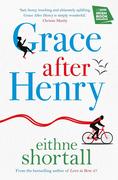
Grace After Henry
Grace After Henry - 'A deftness reminiscent of Marian Keyes' Irish Times: ab 5.99 €- Shop: ebook.de
- Price: 5.99 EUR excl. shipping